
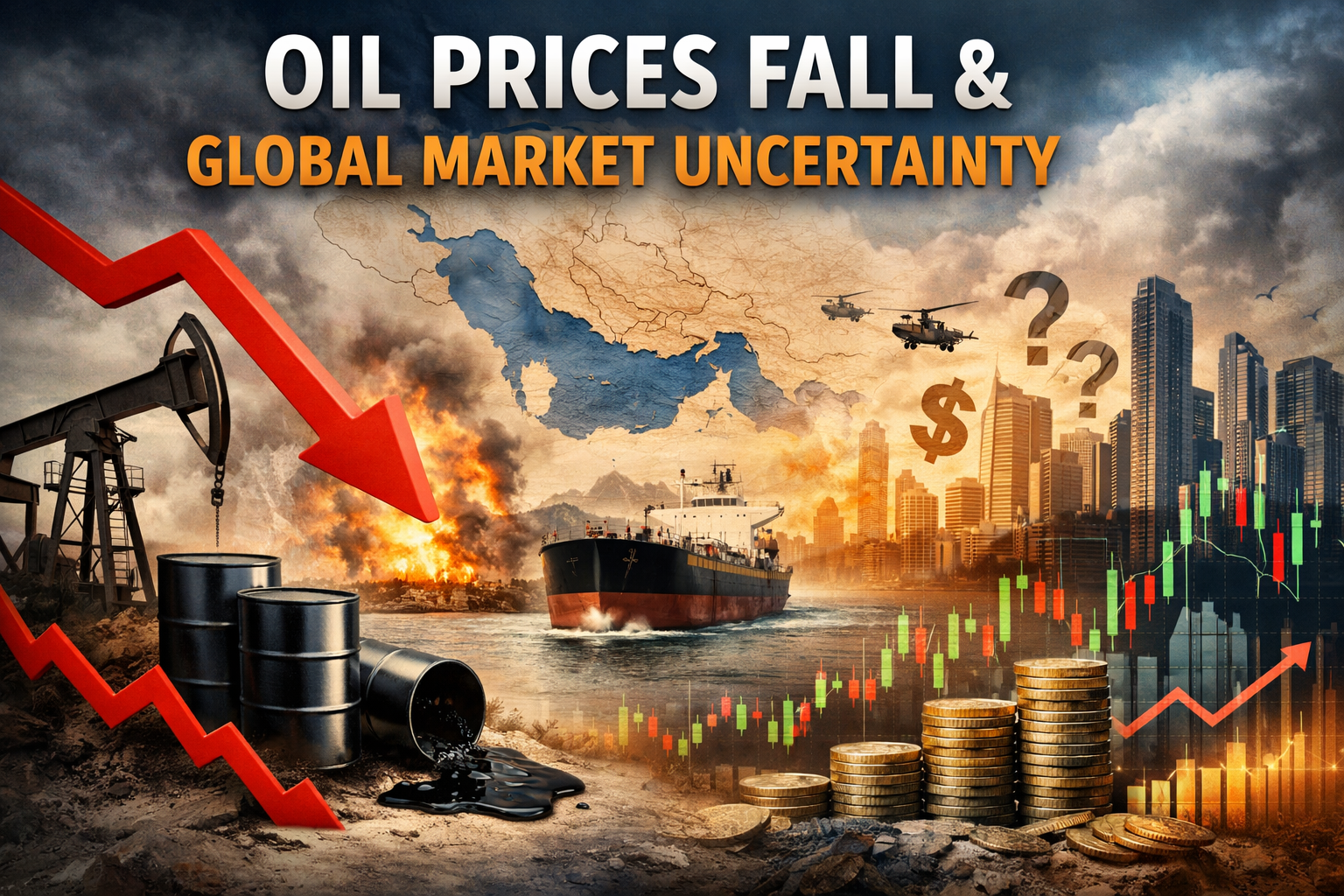
Topic Intro:-Global financial markets are passing through a phase of adjustment, where temporary comfort exists alongside deeper underlying risks.Over the last few days, the fall in oil prices has given a sense of easing pressure, suggesting that conditions might be stabilizing. But a closer look at recent market trends and global developments as of 6 April 2026 shows that uncertainty has not disappeared — it is still strongly present beneath the surface. |
Highly Reactive Markets: Stability Still Out of ReachAt present, the biggest challenge in the market is its highly reactive behavior:Any positive update quickly pushes prices higher Even a minor negative development can trigger sharp sell-offs This clearly indicates that the market is not following a stable trend, but is instead reacting instantly to news and events. In simple terms: “Everything looks normal on the surface, but underneath, the market remains highly unstable.” |
Today’s Oil Market Snapshot (6 April 2026): Crude Prices Hold Firm Above $100As of 6 April 2026, the global oil market continues to trade at elevated levels, with crude prices holding firmly above the $100 mark. Despite recent fluctuations, both major benchmarks are showing resilience.Brent crude is currently trading in the range of $107–109 per barrel, while WTI crude remains around $104–106 per barrel. These levels indicate that the market is still under the influence of strong underlying factors. The primary reason behind these high prices is ongoing geopolitical tension in key oil-producing regions, which has created concerns about potential supply disruptions. At the same time, global demand for energy remains stable, adding further support to prices. Although there have been minor dips in recent sessions, the overall trend suggests that oil prices are staying elevated due to uncertainty in supply conditions and cautious market sentiment. In simple terms: Oil prices may fluctuate in the short term, but they are still strong because the global situation remains uncertain. |
What High Oil Prices Above $100 Indicate for the MarketOil had earlier jumped to nearly $110–112 per barrel However, this should not be seen as a trend reversal, but rather a short-term adjustment in prices. Key Point: Conclusion: Stock Market Overview: Understanding Global Market MovementsCurrent Situation:
Interpretation:Investors are staying cautious, avoiding any strong buying positions. At the same time, there is no sign of panic selling in the market. This reflects a cautious market stance, where participants are observing rather than making decisive moves. Safe-Haven Assets as a Measure of Market RiskGold continues to hold firm, showing resilience in the current market. Meanwhile, bond yields are either steady or edging slightly lower. Interpretation:Investors continue to stay cautious, keeping away from high-risk positions. Market concerns still linger, indicating that fear hasn’t fully faded. What’s Causing Oil Prices to Fall?Short-Term Factors Behind the Decline
Talks of possible US–Iran negotiations improved sentiment in the market, reducing immediate concerns. This led traders to pull back on heavy buying while locking in profits from earlier gains.Technical Pullback in Prices 2 . Technical Pullback in PricesOil prices had risen sharply beyond $110, pushing the market into overbought territory. As a result, a price pullback became a natural and expected move. 3 . Slight Easing in Supply ConstraintsCertain shipping routes have resumed operations, easing earlier disruptions. Reality CheckThe recent decline is mainly due to changing market sentiment rather than any strong fundamental improvement. Because of this, any negative development could quickly push oil prices higher again. Geopolitics at the Center of Market MovementsUnderstanding the Current Market LandscapeThe conflict in the Middle East continues without a clear resolution:
Risks to Oil InfrastructureRecent developments indicate rising threats to oil infrastructure:
This highlights that supply disruptions can occur suddenly at any time. Strait of Hormuz: A Critical Oil LifelineNearly 20% of the world’s oil supply passes through this strategic route. Risk Outlook:
Markets are closely reacting to every update linked to this route. Why Global Stock Markets Are Showing Mixed SignalsCurrent Trend :-
Positive Factors:-
Negative Factors:-
Core Insight:-
This dual pressure is creating inconsistent signals. Inflation and Interest Rate Pressure (Underlying Risk)Oil–Inflation Link:-When oil prices rise:-
This results in broad-based inflation across the economy. Central Bank Challenge
This creates a difficult policy situation. Market Impact
Supply Chain and Trade ImpactShipping Challenges:-
This leads to:
Global Trade Effects
Reasons:
Why Market Volatility Remains HighKey Drivers:-
Outcome
Investor Behavior: Key InsightsCurrent Approach
Psychological Trendnvestors are focused on capital protection:
Impact on the Global EconomyIf Current Conditions Continue:
Worst-Case ScenarioIf oil prices reach $120–140:
Impact on India:As a major oil-importing country, India is directly affected. Negative Impact:-
Supportive Measures:-
Overall View:-India remains relatively stable but is still vulnerable to global risks. Future OutlookBest-Case Scenario
Base Scenario
Worst-Case Scenario
Final AnalysisAs of 6 April 2026, the recent drop in oil prices appears to be only temporary relief, while deeper risks remain in place. The market is currently in a fragile balance—where positive developments can drive short-term gains, but structural challenges such as geopolitical tensions, supply risks, and inflation continue to limit sustained growth.
|