
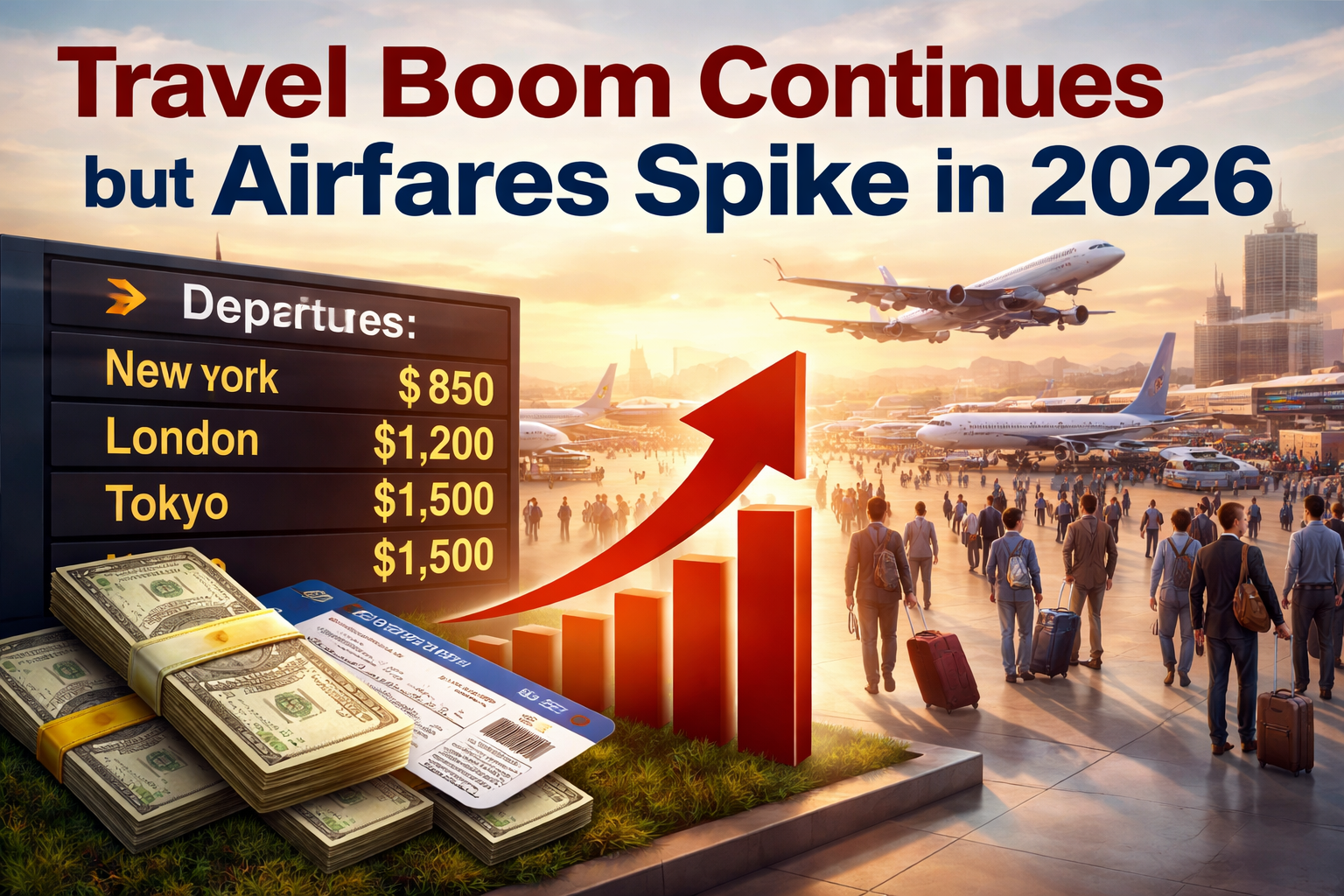
In 2026, the global aviation sector is going through an unusual phase where growth and pressure exist side by side. On one hand, people are traveling more than ever, while on the other, the cost of flying is steadily increasing.
Recent figures show that air travel demand saw a modest rise of about 1% in March 2026 compared to last year, indicating that passenger interest remains stable. Looking ahead, industry projections suggest that overall demand could expand by nearly 5–6% throughout the year, driven by tourism, business travel, and global connectivity.
Despite this positive momentum, airlines are dealing with several challenges that are pushing ticket prices higher. Increasing fuel expenses remain one of the biggest factors, as aviation fuel continues to be costly. In addition, ongoing geopolitical issues and limited aircraft availability are creating supply-side pressure, making it harder for airlines to meet demand efficiently.
As a result, even though more people are choosing to fly, they are also having to pay significantly more for tickets. This combination of strong demand and rising fares is shaping the aviation industry’s outlook in 2026.
In simple words:
Travel demand is high, but expenses are increasing even more quickly.
Why Travel Demand Is Still Holding Strong
1. Growth Continues Even During Uncertainty
Despite ongoing global challenges, the demand for air travel remains steady and continues to grow. Current projections suggest that worldwide passenger demand could increase by around 5–6% in 2026, showing consistent recovery and expansion.
In major markets like the United States, travel activity is still very high. For example, more than 78 million passengers flew in March 2026 alone, reflecting strong consumer interest in flying.
What’s notable is that even with rising fuel costs and higher ticket prices, demand hasn’t seen any major decline. People are still choosing to travel for work, vacations, and personal reasons.
Overall, this indicates that air travel demand is quite resilient and continues to perform well, even in times of economic pressure and global uncertainty.
2. Premium & Business Travel Remain Strong
Airlines are increasingly focusing on premium services as this segment continues to perform well. Many carriers are expanding their business class and premium economy cabins to meet the rising demand from high-paying passengers.
Corporate travel has also made a solid comeback, with companies resuming in-person meetings, conferences, and international trips. This has significantly boosted demand in the premium segment.
In some cases, airlines are even redesigning aircraft layouts, with nearly 40–50% of seats being allocated to premium categories. This shift highlights where the most consistent revenue is coming from.
High-income travelers and business passengers are playing a key role in maintaining airline earnings, which in turn helps keep overall travel demand stable despite rising ticket prices.
3. Travel Behavior Is Changing, Not Declining
Travel patterns in 2026 are evolving rather than weakening. Instead of canceling trips altogether, many travelers are simply choosing different destinations and travel styles.
People are becoming more cautious and are avoiding regions that are seen as risky or unstable. At the same time, safer and more popular areas—such as Southern Europe—are seeing increased demand.
Another noticeable trend is the rise in short-haul travel. Many passengers now prefer shorter, more affordable trips instead of long-distance international journeys, helping them manage both cost and uncertainty.
This clearly shows that demand is not decreasing—it’s just shifting in response to global conditions and traveler preferences.
4. Strong Long-Term Demand Outlook
The future of the aviation industry looks highly promising, with long-term growth trends remaining strong. Industry forecasts suggest that global air travel demand could double by the year 2050, driven by population growth, rising incomes, and increased connectivity.
The Asia-Pacific region, especially countries like India and China, is expected to play a leading role in this expansion. Growing middle-class populations and increasing access to affordable air travel are key factors behind this surge.
All of this indicates that aviation is not just growing in the short term, but is set to remain a major long-term growth sector worldwide.
Why Flight Ticket Prices Are Rising in 2026 (SEO Friendly)
1. Jet Fuel Prices – The Biggest Reason Behind Expensive Airfares
One of the major reasons why flight ticket prices are increasing in 2026 is the sharp rise in jet fuel costs. In several global markets, jet fuel prices have reached nearly $195 per barrel, while in the United States, prices are around $4.5 per gallon. In India, Aviation Turbine Fuel (ATF) prices are also rising लगातार, with monthly increases of around 8% or more.
Fuel is the biggest expense for airlines, contributing लगभग 35–45% of their total operating cost. Because of this, even a slight increase in fuel prices directly impacts airfare.
This is why whenever fuel prices go up, airlines quickly increase ticket fares. As a result, passengers are seeing higher flight ticket prices across both domestic and international routes.
2. War & Oil Supply Disruption Increasing Flight Ticket Prices
Another major factor behind rising airfares in 2026 is global conflict and disruption in oil supply. Ongoing tensions in the Middle East have created uncertainty in the global energy market, directly impacting fuel availability.
One of the most critical routes, the Strait of Hormuz, plays a key role in transporting a large portion of the world’s oil. Any risk or instability in this region affects global supply chains.
Due to these disruptions, crude oil prices have surged above $100 per barrel, increasing overall fuel costs for airlines. Since fuel is a major expense, airlines are left with no option but to pass on these higher costs to passengers through increased ticket prices.
Result: Impact on Airlines and Ticket Prices
- Jet fuel prices increase sharply, putting immediate pressure on airlines
- Airline operating costs rise significantly, making flights more expensive to run
As a result, airlines are forced to increase ticket prices, directly affecting passengers.
3. Airline Loss Pressure & Fare Hikes
Airlines in 2026 are operating under intense financial pressure as overall costs continue to rise. From fuel expenses to maintenance and operational charges, the burden on carriers has increased significantly.
Because of this, some industry leaders have even raised concerns about potential financial instability and possible bankruptcies if the situation does not improve. This highlights how serious the cost pressure has become for the aviation sector.
To manage these losses, airlines have already started increasing ticket prices. On several routes, fares have gone up by nearly 20%, making air travel more expensive for passengers.
Airlines’ Tough Choice in 2026
Airlines are currently facing a difficult situation with rising costs and shrinking margins. Because of this, they are left with only two practical options:
✔️ Increase ticket fares
✔️ Or absorb heavy financial losses
In reality, most airlines are choosing to raise fares. This allows them to cover rising fuel and operational costs and avoid deeper financial losses.
4. Fuel Surcharges & Additional Charges Increasing Airfares
Apart from base ticket prices, airlines in 2026 are also adding extra charges to manage rising costs. One of the biggest additions is fuel surcharges, which are directly linked to increasing fuel prices.
These surcharges are especially high on international routes, where operating costs are already greater. In many cases, passengers are seeing a significant jump in the total fare due to these added fees.
For example, on some routes, fuel surcharges have increased by more than 200%, making tickets much more expensive than before.
These additional or “hidden” costs may not always be obvious at first glance, but they play a major role in increasing the final price that passengers pay.
5. Aircraft Supply Constraints Driving Higher Airfares
Another key reason behind rising flight ticket prices in 2026 is the shortage of available aircraft. Airlines are struggling to expand their fleets as planned due to multiple challenges.
Many new aircraft deliveries are getting delayed, which is slowing down airline expansion. At the same time, some existing planes are temporarily grounded because of maintenance or technical issues. This reduces the number of flights airlines can operate.
As a result, overall seat availability remains limited while passenger demand stays strong.
Result:
Limited capacity + steady demand = higher ticket prices
This imbalance between supply and demand is a major factor pushing airfares higher across both domestic and international routes.
6. Longer Flight Routes Increasing Ticket Prices
In 2026, airlines are also facing higher costs due to changes in flight routes. Because of ongoing conflicts and restricted airspace in certain regions, many airlines are avoiding risky zones for safety reasons.
As a result, flights are now taking longer alternative routes instead of the usual direct paths. These extended routes increase flying time and lead to higher fuel consumption.
Naturally, this raises overall operational costs for airlines. To manage these extra expenses, airlines pass the burden on to passengers through increased ticket prices.
7. Overall Cost Explosion in the Aviation Industry
It’s not just fuel—airlines in 2026 are dealing with rising costs across almost every area of operations. This overall cost surge is making it much harder for airlines to maintain profitability.
Key expenses increasing include:
- Staff salaries and labor costs
- Aircraft maintenance and expensive spare parts
- Airport charges, taxes, and service fees
According to industry trends, the growth in operating costs is now outpacing revenue growth. This imbalance is putting serious financial pressure on airlines worldwide.
Airlines Facing a “Perfect Storm”
Right now, airlines are dealing with multiple challenges at the same time—rising fuel prices, higher operational costs, supply constraints, and global uncertainties.
This combination has created a “perfect storm” situation for the aviation industry, where maintaining profits has become extremely difficult.
🔺 Cost Side Pressures on Airlines
- Rising fuel prices increasing overall operating expenses
- Geopolitical risks creating uncertainty and higher route costs
- Limited aircraft supply reducing capacity and efficiency
These factors are significantly pushing airline costs upward, making operations more expensive.
🔻 Demand Side Outlook
- Travel demand is still stable and holding strong
- However, it may weaken if ticket prices continue to rise
Expert Insight:
If airfares remain high for a longer period, passenger demand could gradually slow down as travelers become more price-sensitive.
Real Impact on Passengers
The rising cost of air travel in 2026 is directly affecting passengers in multiple ways. Ticket prices have increased significantly, making travel less affordable for many people.
- In some cases, international flight fares have crossed $1,900 or more
- Last-minute bookings have become extremely expensive
- Budget travel is now much harder to manage
As a result, travelers are now forced to change their approach. Planning ahead and booking tickets early has become essential to avoid high costs and secure better deals.
Impact on Airlines
The surge in costs is not just affecting passengers—it is also putting serious pressure on airlines worldwide. Many carriers are struggling to maintain profitability in this challenging environment.
- Airline stocks are facing downward pressure due to uncertain market conditions
- Profit margins are shrinking as costs rise faster than revenue
- Some airlines have even entered an “emergency mode” to manage financial stress
Strategies Adopted by Airlines
To survive and stay competitive, airlines are taking several key steps:
- Cost Cutting: Reducing operational expenses wherever possible
- Route Optimization: Focusing on profitable routes and cutting less efficient ones
- Premium Focus: Targeting high-paying business and premium-class customers
These strategies are helping airlines manage the crisis, but the situation remains challenging as cost pressures continue to rise.
Impact on Economy & Markets
The ongoing situation in the aviation sector is also influencing the broader economy and financial markets, creating a mixed outlook.
- Airline stocks are declining as rising costs and shrinking margins worry investors
- The energy sector is gaining strength due to higher crude oil and fuel prices
- Tourism demand remains stable for now, but there are concerns about future slowdown if travel costs continue to rise
Overall, the global economy is showing mixed signals—while some sectors are benefiting from current trends, others are facing pressure. This imbalance reflects the wider impact of rising costs and global uncertainty in 2026.
Future Outlook
Short Term (2026)
In the near term, the aviation industry is expected to remain under pressure, with no immediate relief in sight for passengers.
- Flight ticket prices are likely to stay high throughout 2026
- Fuel costs will continue to be the main factor influencing airfares
- Airlines may further increase ticket prices to manage rising expenses
Overall, travelers should be prepared for expensive air travel in the short term, as cost pressures are unlikely to ease quickly.
Medium Term Outlook
Looking ahead to the medium term, there is a possibility of some stability in the aviation sector, depending on key economic factors.
- If crude oil and jet fuel prices begin to stabilize, flight ticket prices may also stop rising and become more stable
- Governments in some countries may step in with supportive measures, such as controlling fuel price hikes or reducing taxes on aviation fuel
Overall, while the situation is currently challenging, some relief in airfares could be expected if fuel markets calm down and policy support is introduced.
Long Term Outlook
Over the long term, the future of the aviation industry remains strong and growth-oriented despite current challenges.
- Air travel demand is expected to keep increasing as global connectivity and income levels rise
- The aviation industry will continue to expand with more routes, airlines, and passenger capacity
- Introduction of new aircraft, better fuel efficiency, and advanced technology may help reduce operating costs over time
In the long run, these improvements could make air travel more affordable and sustainable, even though short-term pressures remain.
Final Conclusion
The aviation industry in 2026 is facing a unique and contrasting situation. On one side, passenger demand remains strong with steady growth in global travel. On the other side, rising costs are putting heavy pressure on airlines.
- Demand is strong – passenger traffic is stable and continues to grow
- Costs are rising rapidly – due to fuel prices, geopolitical tensions, and supply constraints
As a result:
- Flights are operating at high occupancy levels
- Ticket prices have increased significantly
In simple terms:
Travel demand is still strong, but increasing costs are making air travel more expensive for everyone.
What Will Decide the Future of Air Travel
The direction of the aviation industry in the coming years will largely depend on a few critical factors:
- Oil Price Trends: Stable or falling fuel prices could bring relief in ticket fares, while rising prices may keep airfares high
- Geopolitical Stability: Fewer conflicts and stable global conditions can improve airline operations and reduce costs
- Airline Capacity Expansion: Faster aircraft deliveries and fleet expansion can increase seat availability and help control prices
These factors will play a key role in determining whether air travel becomes more affordable or remains expensive in the future.